The Peripheries of Our Solar System and the Search for Planet X

In 2015, astronomers at Caltech proposed the existence of a giant planet residing in the outer solar system. While this planet, called Planet X or Planet 9, was hypothesized based on mathematical modeling and computer simulations as opposed to observations, its existence would help explain the abnormalities in the orbits of a handful of major TNOs. Planet X is predicted to have a mass about 10 times larger than Earth, an average orbital radius of 600AU, and an orbital period of somewhere between 10,000-20,000 Earth years.
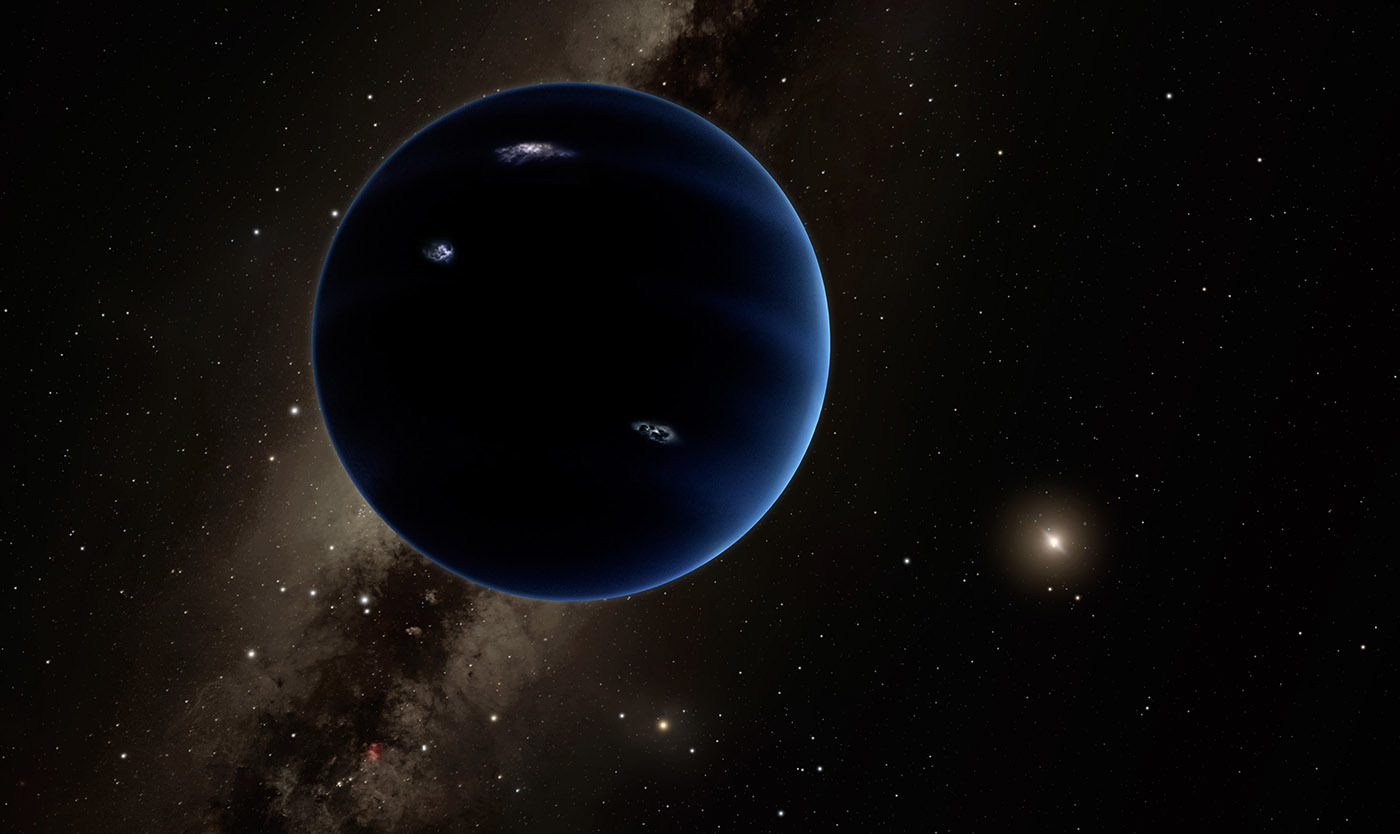
The  discovery of The Goblin later in 2015, a TNO with a semi-major axis of about 80AU, corroborates this theory. The irregularities in its orbit are consistent with the existence of Planet X and its effects on The Goblin’s orbit. 

Recently in 2018, another TNO, nicknamed Farout, was discovered. Farout has a semi-major axis of about 120AU, making it the most distant object that resides in our solar system ever observed. Observations from the Magellan telescopes at Las Campañas Observatory confirmed the orbital radius, and showed that Farout has a radius of about 500km. Its orbital period is fairly slow, so astronomers haven’t been able to observe Farout’s orbit for long enough to determine whether the hypothetical Planet X could be warping its orbit. It is predicted that Farout has an orbital period of more than 1,000 Earth years.

Solar System distances to scale

Given that The Goblin has an orbital period of about 32,000 Earth years and astronomers were already able to confirm that this Planet X would explain its orbital irregularities, astronomers will hopefully be able to do the same for Farout sometime in the near future. If Farout’s orbit is consistent with this theory as well, astronomers may be one step closer to determining if there really is a 9th massive planet in our solar system.
Exotic Energy Concepts

With the pressing concerns regarding climate change, alternative sources of energy have been a prevalent topic of discussion. These sources range from feasible ideas such as nuclear power to ideas a bit more far fetched, such as harnessing energy from waves. While the alternative energy sources in question are all relatively feasible, there are some concepts that seem like the works of sci fi novelists. The application of these concepts is nearly impossible, but the methods and their ways of harnessing energy are quite interesting.

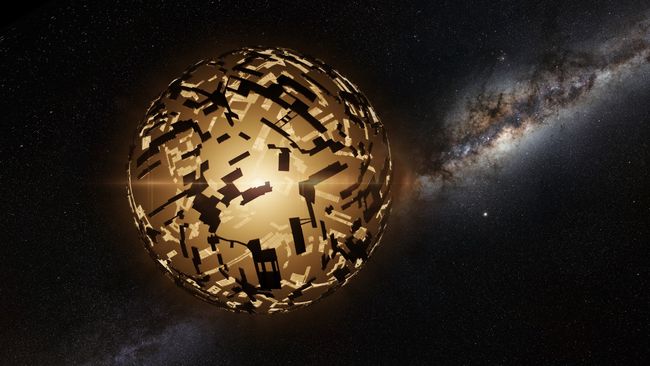
One such concept is known as the Dyson Sphere. Theorized by physicist Freeman Dyson, these spherical megastructures would encapsulate a civilization’s host star and ideally harness all of the solar radiation produced by said star. According to Dyson, these spheres would only be necessary for an intelligent civilization far larger and with far larger energy demands than we do. This civilization would need to be capable of travel about the solar system, as once the Dyson Sphere is constructed, the civilization would reside there. One method Dyson proposed that could be applied to create this sphere would be to deconstruct a planet in their solar system- ideally a large one such as Jupiter- and redistribute the mass into a spherical shell. Instruments capable of harnessing the Sun’s energy would be built on the inner face of the sphere, and the civilization would need to have a method of radiating the additional energy so that the Dyson Sphere does not melt.

Another concept would be to somehow get a mini black hole to orbit a civilization’s planet. The late Stephen Hawking claimed that a mountain-sized black hole could suffice all of Earth’s energy demands and then some; this energy is produced by harnessing Hawking radiation. Along the event horizon, particle pairs pop into existence. The pair is composed of a particle and antiparticle, which will annihilate each other right after they are created. Sometimes, one of these particles gets absorbed by the black hole and the other is released as radiation (This is also how black holes shrink and die off over time). Hawking stated that a black hole of that size would produce high-energy electromagnetic radiation at a rate of about 10 million megawatts.

While these concepts are almost entirely implausible, it is fascinating nonetheless to think about whether or not there are other civilizations in our universe advanced enough to employ methods as intricate as these.

Parker Solar Probe: Understanding Coronal Dynamics

Launched on August 12th, 2018, the Parker Solar Probe will make the closest approach to the Sun in history. Over a time period of roughly seven years, PSP will use Venus for gravitational assist to make successively closer approaches to the Sun at distances as small as 4 million miles from the sun’s surface. PSP needs to get this close to breach the corona, or the Sun’s atmosphere. There are a handful of puzzling aspects about the corona, including how energy moves about the corona and how solar wind is accelerated.

One important discovery made this past December was the switchback, a reversal in the direction of the Sun’s magnetic field. During a switchback, a magnetic field radiating away from the Sun is bent back around and points back towards it. The origins of these switchbacks is still unknown, but they offer an explanation for how solar wind can be accelerated and why there are relatively large waves of solar wind at times.

Another area of research that PSP is gathering data for is the path that solar wind takes throughout its “lifetime”. The Sun is rotating, and so is the solar wind around it. However, when the solar wind reaches Earth, it appears to be moving radially away from the Sun. Finding the point where the solar wind is freed from its centripetal motion will provide insight on how the Sun spends its energy throughout its life, and such developments could allow heliophysicists to study other distant stars and their life cycles.

The future is very bright for heliophysics; PSP is continually surprising scientists with its discoveries, and if the data keeps coming in like it is now, PSP will have been significantly more productive than was anticipated.

WFIRST: The Newest Vanguard of the Mission to Understand Dark Energy

At some point this decade, a new space observatory will be launched into orbit; one unlike any that we have seen before with extraordinary equipment and capabilities. WFIRST, the Wide-Field InfraRed Survey Telescope, could potentially revolutionize what astronomers know about our universe and how it behaves by focusing on three major categories: dark energy, exoplanet detection, and infrared astrophysics.

Artist’s Rendition of WFIRST. Source: NASA

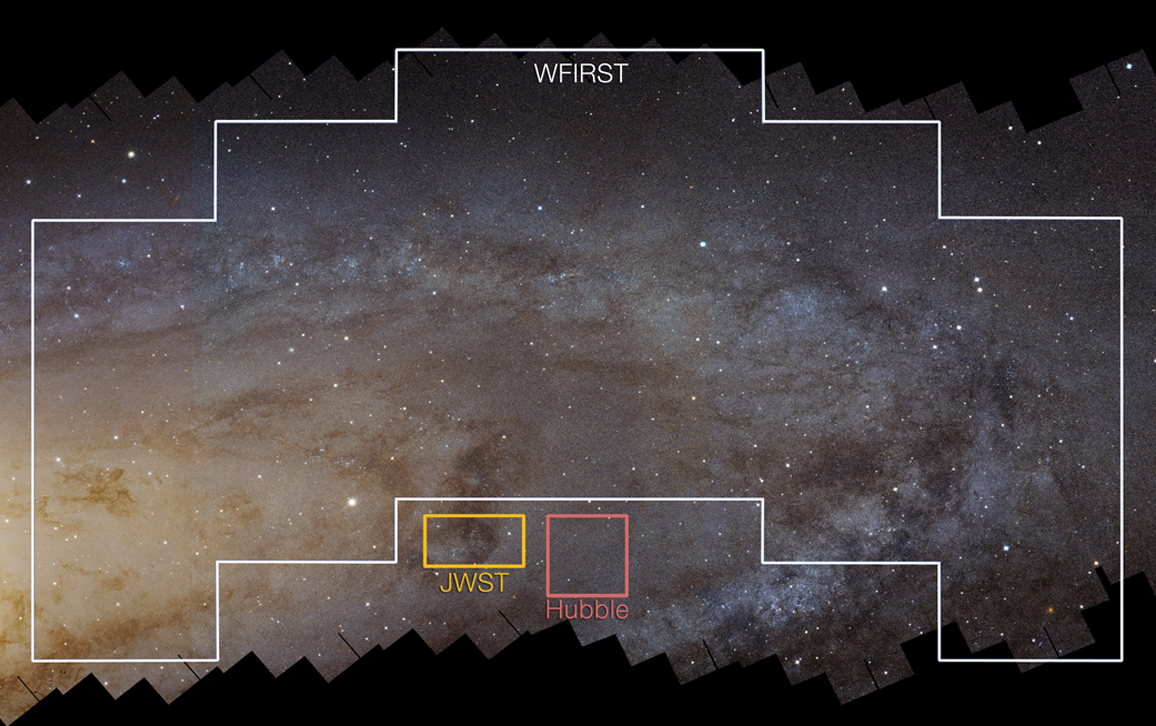
WFIRST has two major features that make it stand out above other observatories within its niche: it has an enormously wide field of view (roughly 100 times the area of Hubble’s while maintaining the same level of resolution), as well as being equipped with a coronagraph. Coronagraphs block out the glare from a star’s corona to allow its observatory to directly observe things such as the planets that may orbit the star, and protoplanetary disks if the star happens to be younger. Coronagraphs have been utilized in the past with observatories like Hubble, but WFIRST’s coronagraph will be far more advanced and sophisticated.

Field of view of WFIRST compared to Hubble and James Webb Space Telescope. Source: American Scientist

To study dark energy, WFIRST will use its primary mirror, which has a diameter comparable to Hubble’s, as well as its wide-field instrument. With its immense imaging power, WFIRST can study the distribution of mass and matter throughout the universe and how the distributions may have changed as a result of the universe’s accelerating expansion. There are a handful of other ways in which WFIRST will attempt to study dark energy, but in short, understanding dark energy will unlock the secrets of how our universe came to be and the circumstances of its demise.

How a Solar Eclipse Revolutionized Our Understanding of the Universe

Up until the early 20th century, the laws that our universe abided by were best described by Isaac Newton in his Philosophiae naturalis principia mathematica. Newton’s principles still hold true for the most part, as they are the basis of many introductory classical mechanics classes today. Despite being able to model the laws of our universe for the most part, they began to break down when used to describe large-scale phenomena. German Physicist Albert Einstein wanted a model that could describe the laws of the universe in their entirety, so he produced the theory of general relativity, which he published in 1915. One key aspect of the theory of general relativity is that space and time are interwoven and form what is known as the fabric of space-time, which can be warped by massive objects. Because of this, general relativity states that light should be bent when it passes through distorted space-time around these massive objects. The apparent, or observed position of a star may not be its actual location if it is in the background of a much larger object.

Apparent versus actual position of a star behind a foreground white dwarf

Because of limits in technology, the only object large and near enough to use to observe this phenomena was the Sun. The Sun is too bright to be able to observe any stars in the background, but a total solar eclipse on May 29th of 1919 was the perfect opportunity to observe these background stars. Astronomers who conducted the observations knew the actual positions of the stars that were behind the sun during the eclipse. The eclipse lasted for long enough for astronomers to observe that these stars appeared ever so slightly away from their actual locations, but the observations were enough evidence to confirm Einstein’s theory of general relativity.

Image from the May 29th 1919 eclipse

General relativity has yet to be superseded by a better theory, and for the time being best describes the nature of our universe. Had it not been for this eclipse, one can wonder how long it would have taken general relativity to be confirmed, or if it was even capable of gaining the support of other physicists at the time.

Design a site like this with WordPress.com
Get started